Why Jon Sarkin, Why Now
Museum-collected, critically documented, and the market hasn’t caught up.

For most of his life Jon Sarkin (1953–2024) was filed under “medical curiosity.” He was a chiropractor in Massachusetts until a stroke in 1989 rewired him into an artist who never stopped again. Vanity Fair called him an artist savant. The press loved the before-and-after, and almost everyone who met the story never got past it to the work.
That was always the mistake. Right now, it is the discount.
The work
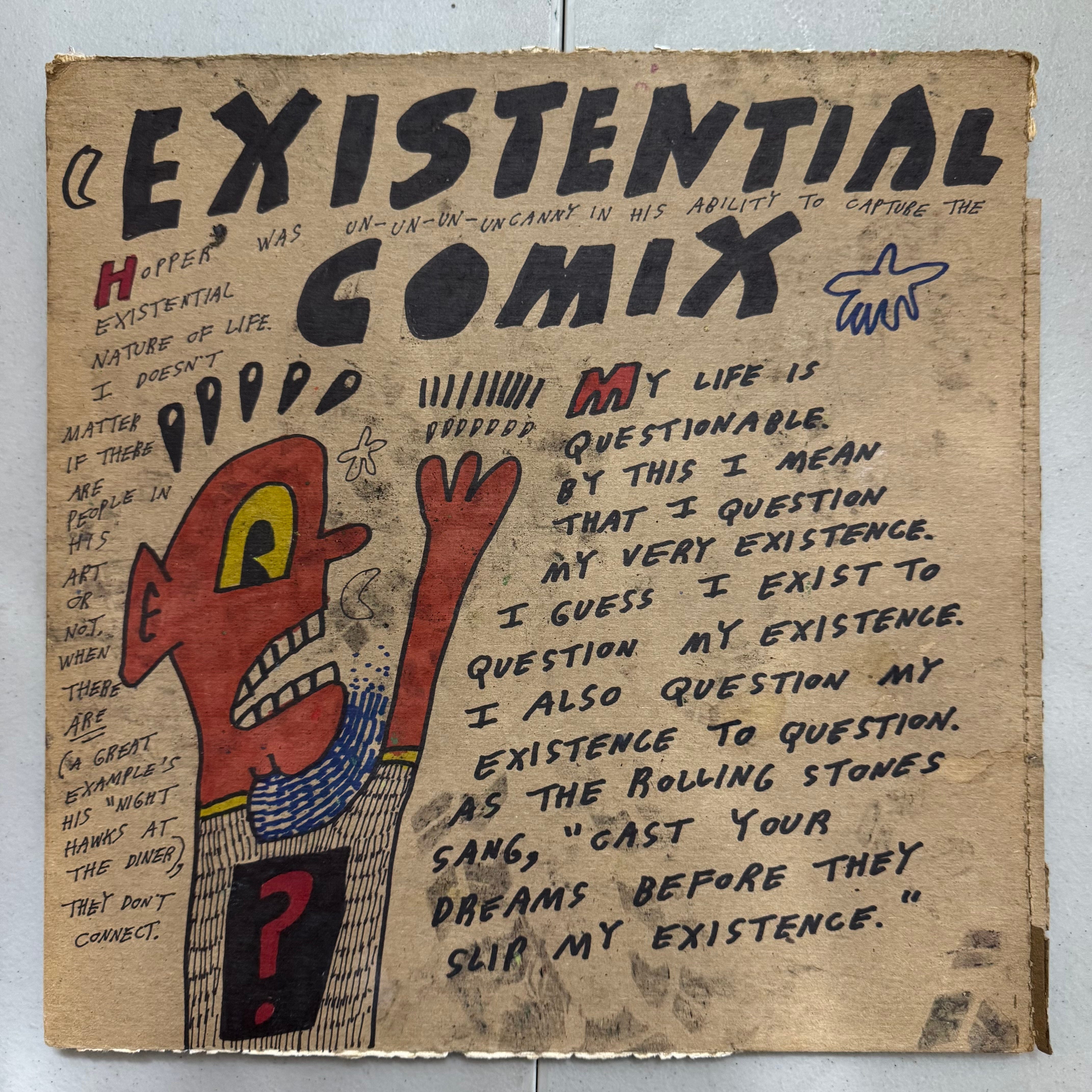
Look past the origin story and you find dense, literate, frequently funny work: text and image crowded together, recurring motifs (eyes, fish, faces, maps, comic-book grammar) worked and reworked with real compositional control. The drawing above is not naive. It is a man doing Edward Hopper criticism inside a comic panel, and misquoting the Rolling Stones on purpose while he does it.
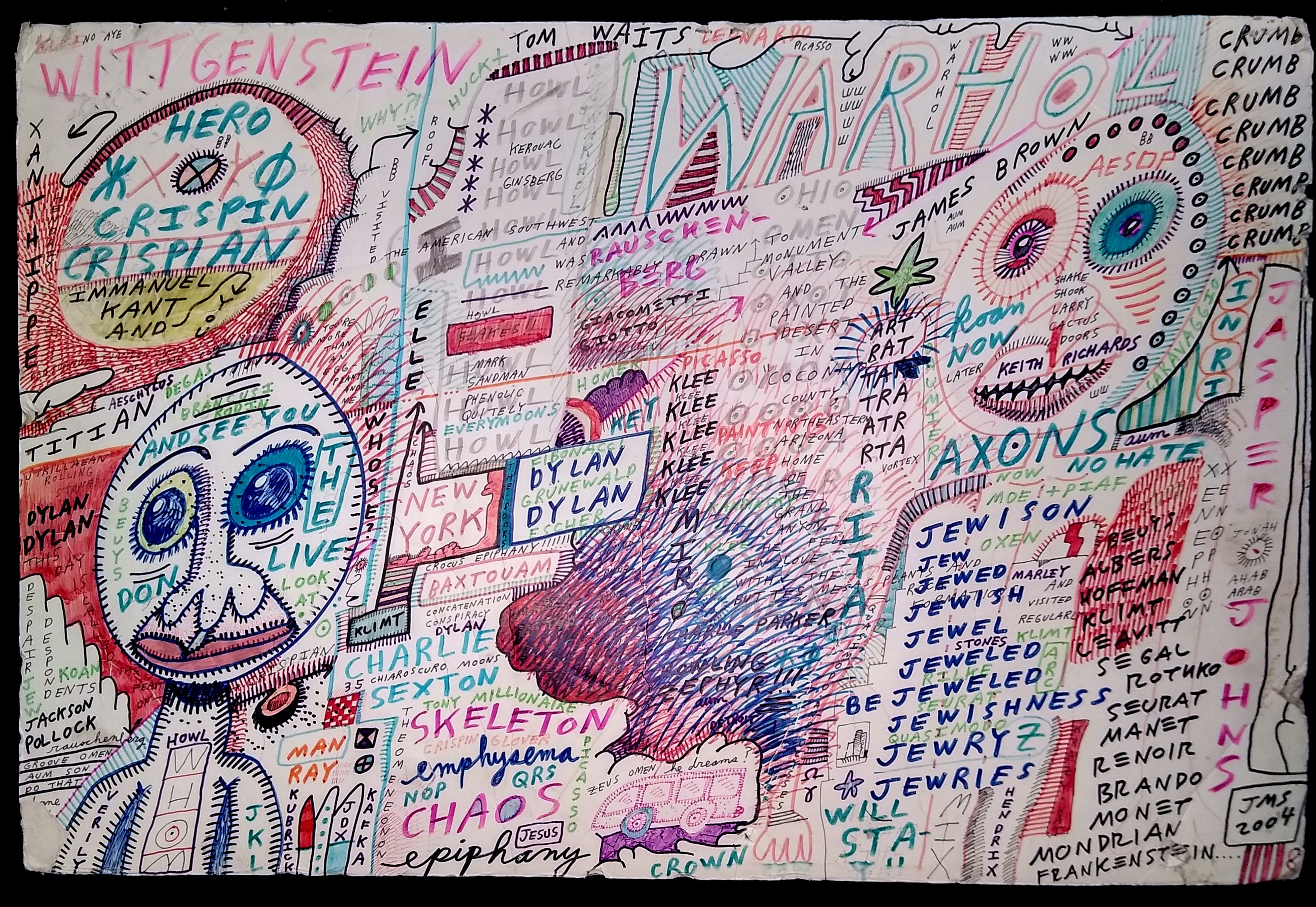
The lazy read on Sarkin is anguish, the compulsion of a damaged brain. The accurate read is the one art historian Colin Rhodes puts in print, in a peer-reviewed study from Cambridge University Press: a craftsman with deep genre literacy, working the same text-and-image vein as Johns, Rauschenberg, Twombly, and Basquiat. Jon knew exactly where he stood, too. In one 2022 drawing he lists his own pantheon: Beuys, Botticelli, Brancusi, Basquiat, Bosch, and, because he was funnier than all of them, Yogi Berra.
When I asked him about the movie deals and the magazine profiles, he waved them off:
“Mark, I go to my studio and I make art. Seven days a week, eight hours a day. Everything else is a by-product of that.”
He kept that schedule until the day he died.
Press celebrated
The public record runs three decades deep, built by people with no stake in his market. The New Yorker bought his drawings. Ira Glass told his story on This American Life in 2000. GQ, The Guardian, ARTnews, The New York Times, ABC Primetime. When he died, Murray Whyte’s Boston Globe retrospective called him an outsider art legend. And his biography, Shadows Bright as Glass, was written by Amy Ellis Nutt, who was a Pulitzer finalist for her reporting on Sarkin himself before winning the 2011 Pulitzer Prize for feature writing.
Most living artists never assemble a file like this.
Institutionally recognized
The museums got there before the market did. Centre Pompidou. deCordova. The American Visionary Art Museum. The Cape Ann Museum, which acquired his work in 2025. The Addison Gallery of American Art at Phillips Academy. And the MoMA Archives, where his drawings sit in the Calvin Tomkins Papers beside Tomkins’ research files on Duchamp and Rauschenberg.
For an artist you can still collect for three figures, that is a strange list. It reads like the early shape of a canon placement.
A closed body of work
Jon died in July 2024 in his studio, in his favorite chair, surrounded by thousands of works strewn about as if an art bomb had gone off. One had. It detonated daily for thirty years, roughly twenty thousand works in all, and it will never produce another. The estate holds ten to fifteen thousand of them. The rest are already out with collectors, institutions, and owners nobody has fully mapped.
None of it is an asset until it is documented, which is why the estate built the catalogue raisonné: a permanent scholarly entry for every work, a certificate of authenticity tied to each entry, rights managed through ARS. Release is paced, deliberately. The estate’s first duty is to the collectors who already own the work.
The gap
For years this market was illegible. There was no central record, so individual works changed hands far below what an artist held by the Pompidou should command. The catalog fixed the legibility problem, and the repricing has started: since launch, the floor has moved up meaningfully. It has not come close to the recognition above. That distance is the reason to pay attention now, not after the first museum retrospective.
How to begin
You do not need a curator to start.
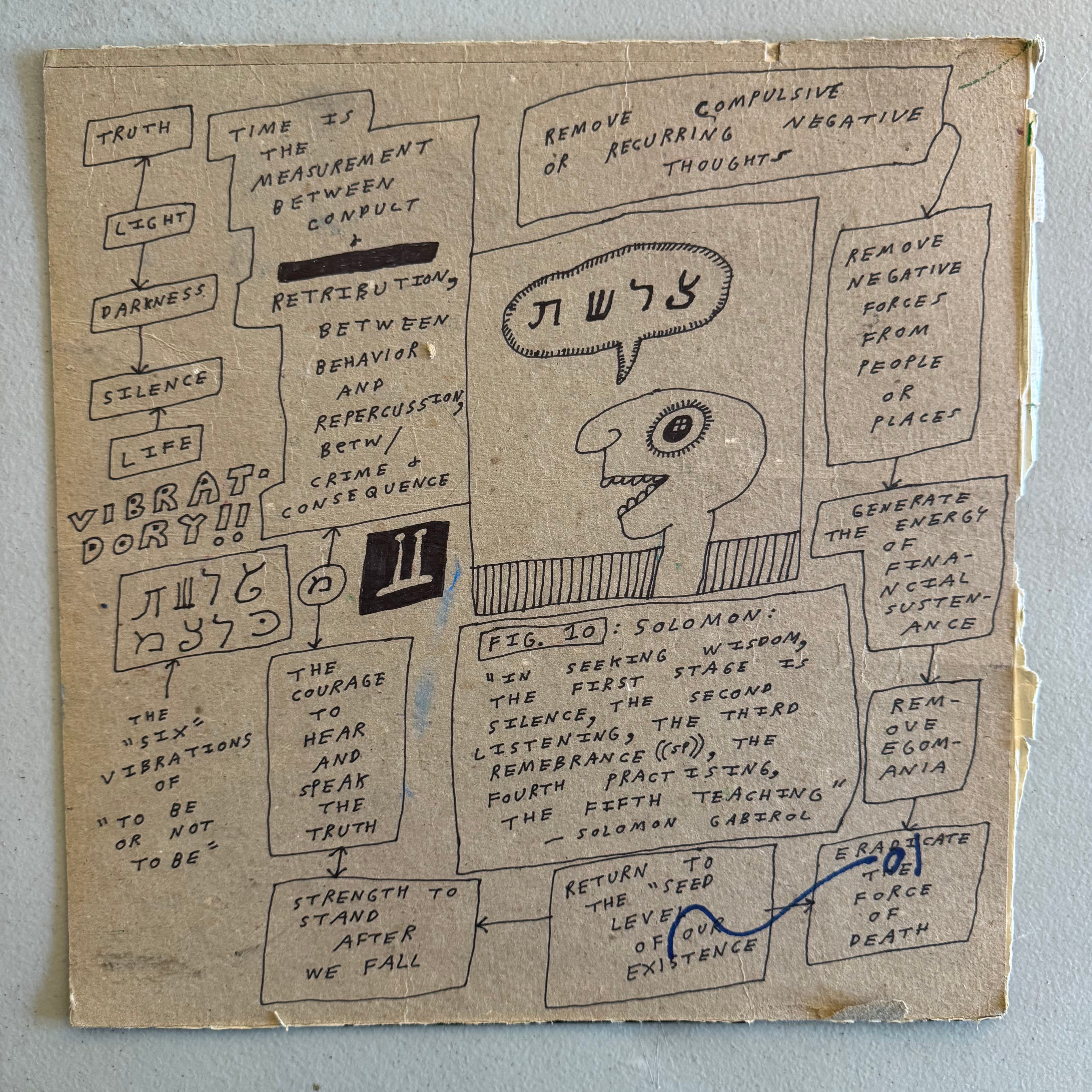
Entry: the album-sleeve drawings. His signature substrate and the fastest way to learn his visual language. From around $800.
Core: mixed-media pieces, where the Johns and Rauschenberg comparison is most visible; several Pompidou holdings share the format.
Anchor: portraits and large-scale work, the rarest tier and the natural museum loans.
Private viewings happen at Fish City Studios in Gloucester, Jon’s studio for his last decade and now the estate’s salon gallery. His marks are still on the walls. Or start with the catalog and the storefront, and write to the estate for the collector packet.
In candor
Two things a serious collector should weigh. The “outsider” tag cuts both ways: a devoted base, and a ceiling the scholarship is built to break. And twenty thousand works is a lot. Jon used to say, “I’m not worried about my art getting damaged. I’ll just make more.” He can’t anymore. Managing that finitude, releasing with discipline against a fixed set, is the estate’s whole job, and you can audit how we do it in the public catalog any time you like.
He did the work. Thirty years of it. The open question is who is paying attention before the rest of the market arrives.
Mark Henderson runs the Jon Sarkin estate. jonsarkin.com